What the platform does
AiCM converts the PDFs linked across a website into inclusive web content that people, search engines, and AI systems can read.
The work begins with discovery, scanning the site and generating a structured catalogue of the document estate. For the first time, organisations see what they hold, where it sits, and the scale of the work involved. Linked PDFs are converted into inclusive HTML, served alongside the original through the secure tag.
Ongoing, organisations define what is correct for their own content. Approved positioning, terminology, and facts are held centrally, and the platform flags inaccuracies in material already online. The original PDF is never altered, and the process is consistent, documented, and repeatable.
Post launch
Once the secure tag is installed on the agreed website, the platform identifies the PDFs linked from across the site and begins learning how visitors interact with that content, which pages they reach, and which documents matter most to them.
PDFs are then converted into inclusive HTML, prioritised based on consumption, served alongside the originals which remain available throughout. No website pages are altered, nothing is rebuilt, and there is no connection to your CMS.
The client can review priority HTML outputs, while monthly reporting sets out usage, demand and the value the service is delivering. Throughout, the platform is monitored and supported after launch.
You can start before procurement completes
The secure tag can be issued with the proposal, which means the 6 to 8 weeks that procurement often runs do not have to delay the early learning phase.
Once installed, the platform begins reading the agreed website and identifying where PDF content sits, how visitors reach it, and which documents appear to matter most. By the time the order is confirmed, this work is already underway.
Converted HTML pages follow once commercials are complete, and because the learning stage is no longer starting from zero, useful service arrives faster after confirmation.
The first three months
The table below sets out how the first three months usually run, including what the platform does at each stage, what is asked of the client, and the outcome at each point. The detail is based on PO purchase; card payment removes the second and third stages.
| Stage | Timing | What happens | What the platform does | What the client does | Client time | Outcome |
|---|---|---|---|---|---|---|
| Proposal received | Before day zero | The commercial proposal is received, with the secure tag available for issue alongside it. | Allows early learning where agreed. | Reviews the proposal and decides whether to add the secure tag. | Commercial review only. | Procurement does not need to delay content learning. |
| Confirmation issued | Before formal order | Commercial confirmation is issued for review. | Supports readiness for launch. | Reviews and issues the confirmation. | Commercial and procurement review. | The service path is agreed. |
| Order confirmed | Commercial close | Commercials are complete and the service can move into full activation. | Prepares the agreed service for live use. | Confirms order completion. | Procurement dependent. | The platform can move from learning into delivery. |
| Receipt of secure tag | Day zero | The client receives the secure tag for the website or websites. | Issues the secure tag. | Passes the secure tag to the relevant developer or CMS team. | One internal handover. | The website can be prepared for platform learning. |
| Secure tag installed | Within week 1 | The secure tag is added across the agreed website pages. | Begins reading website activity, PDF links and content. | Adds the secure tag through the recommended route. | One web team action. | The platform can start learning from the live website. |
| Initial learning | First 21 days after installation | The platform learns where PDF content sits, which pages matter, which PDFs are requested and how visitors reach them. | Builds an understanding of content, demand, priority and activity. | No manual PDF rebuilding is required. | Very low. | The platform identifies which PDFs matter most. |
| First learning period | First 6 weeks | Learning continues and priority is refined. | Identifies priority PDFs and prepares for visitor-facing conversion. | May review early findings or priority areas where useful. | Light review only where useful. | The platform is ready to deliver useful converted HTML. |
| Accessibility statement update | From week 6 | The client may update its accessibility statement to explain use of the AiCM platform. | Supports a managed and proportionate approach to PDF content access. | Updates the statement using normal internal approval. | One content update plus internal approval. | The organisation can explain its approach to improving PDF access. |
What happens first
With the secure tag active on the agreed website, the platform identifies linked PDF content across the site and begins processing supported documents into inclusive HTML.
The original PDFs remain in place and unchanged, and the client's team is not asked to locate, prioritise, audit and rebuild documents by hand. Because the platform learns before it prioritises, effort is focused where it matters most rather than spread evenly across the whole estate.
What visitors see
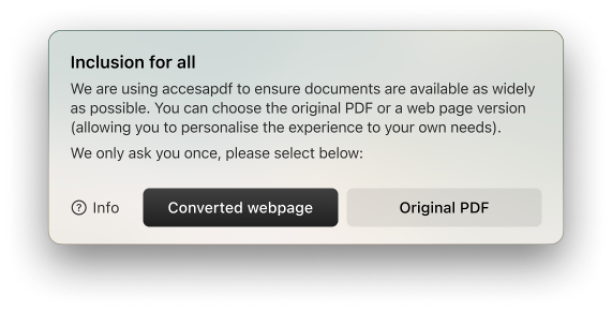
Visitors are offered an inclusive HTML version of the document, served alongside the original PDF, which remains available throughout.
The HTML version is easier to read, navigate, search, enlarge, translate and use across devices, which supports people who find PDFs difficult to use and makes the published content more readable for AI systems.
The website itself remains familiar to visitors, the CMS is not replaced, and the visitor experience improves without the organisation having to rewrite its website.
Beyond month two
Once priority HTML delivery begins, the service settles into a monthly rhythm of conversion, reporting and light review. Optional capabilities for content validation and external content location can be added from month four onward.
| Stage | Timing | What happens | What the platform does | What the client does | Client time | Outcome |
|---|---|---|---|---|---|---|
| Priority HTML delivery | Month 2 | Priority PDFs are made available as inclusive HTML pages alongside the original PDFs, which remain in place. | Converts priority documents into inclusive HTML and supports visitors on the client's behalf. | May review initial priority pages where useful. | Light review only where useful. | Visitors get a better way to read important PDF content. |
| First monthly report | End of month 2, or as agreed | The client receives reporting on what the platform has found and what it is doing. | Reports on usage, priority content, visitor demand, support usage and AI traffic indicators where visible. | Reviews the report. | Report review only. | The organisation has evidence of usage, demand and value. |
| Service rhythm established | Month 3 | The platform converts priority PDFs, supports visitors and reports each month. | Maintains the service, monitors usage and continues improving access. | Reviews reporting and requests changes when needed. | Light ongoing review. | The service becomes part of normal website management without becoming a manual project. |
| Content validation (Service option) | Month 4 onward | Client updates the system with core brand rules and flags master control documents. | Content analysis across site to site and website to websites, running comparison models based on activity and value. | Reviews the report. | Report reviews only. | The organisation has evidence of required activities, actions and priorities. |
| Content location, external (Service option) | Month 6 onward | Based on identified documents, external location of assets is reviewed. | Aligns the master list of assets so those that should not be in use are identified. | Approves the document removal request or manages removal. | Ongoing following review and desired action. | Control of the brand from an external position. |
See the platform working
A separate page sets out a visual explanation of how the platform works, showing the role of the secure tag, the original PDF, the converted HTML page and the route the visitor takes.
Digital, procurement, legal and senior stakeholders find this view useful before going into detail, and it is intended as an overview rather than a technical requirement.
Visitor experience
A separate page shows what people see when the platform is active, explaining the routes available to visitors and how the original PDFs and inclusive HTML versions are presented.
It also illustrates how the platform supports people who find PDFs difficult to use, while the website itself remains familiar throughout.
What the client sees
A managed service continues working after launch, reducing manual conversion effort, limiting operational distraction, and giving PDF content a clearer route to reach more people and AI systems.
The client gains visibility of which PDFs matter most, supported by reporting that covers usage, demand, visitor support and the value the service is delivering, and where useful, converted HTML pages can be reviewed and changes requested.
The model supports digital teams without making PDF conversion their full-time project.
Conversion quality
Converted HTML pages are built from the source PDF, and where the original has limited structure, unusual formatting, scanned content, complex tables, embedded content or designer-led layout, the HTML version may not match the visual layout of the source in full.
The purpose of the HTML is readability, access, searchability, usability and AI readability, rather than visual reproduction of the original. The platform is making the published information more usable, not recreating the design detail of the source.
Reviewing the first priority converted pages can be useful, particularly for important documents, and HTML pages can be updated or modified on request.
Where translation is used, the platform draws on generated document translation rather than conversational interpretation, with accuracy on this type of translation typically reaching 90%.
Availability after launch
The platform is monitored for uptime and performance, with monitoring published openly on the system availability page.
If the platform is unavailable, the secure tag stays silent on the page: no error is returned, page elements remain intact, and website functionality continues without disruption. This failure-mode behaviour has been tested, and the original PDF remains available through the client website throughout.
How the platform supports AI readability
AI systems increasingly read website content on behalf of people, and PDF content can be harder for those systems to access, interpret, summarise or represent reliably.
Inclusive HTML improves the chance that published information is read properly, reducing the risk that important content is missed, misunderstood or misrepresented when an AI system encounters it.
Correct AI interpretation cannot be guaranteed in any given case; the platform improves the chance of accurate reading, not the certainty of it.
Accessibility statement update
From around week 6, it can be useful to update the organisation's accessibility statement to explain that the AiCM platform is being used to improve access to PDF content.
Updating the statement shows a practical and proportionate approach, recognising that manual conversion of the historical PDF estate would create disproportionate effort, and that the organisation is prioritising the documents serving the highest visitor demand.
It also helps communicate the support being provided to people who find PDFs difficult to use. The update should be reviewed through the organisation's normal internal approval route.
Controlling the external view
Introduction, brand oversight
Brand control (service option) runs through web content publication, from draft to live page. PDFs sit outside that workflow. AI search and AI agents now read what those PDFs say and present it to people the organisation has never met.
The gap in practice
A PDF published years ago still represents the organisation today in the wording it carried at publication. A correction to a PDF requires someone to know the document exists, find it, and reissue it. The PDFs that need correcting are usually the ones no one has looked at in years.
What it costs at executive level
For the brand owner, the consequence is AI misrepresentation, incorrect brand, and incorrect positioning. For the CEO, the same content carries regulatory exposure on what the organisation is publishing. For the CFO, it is the financial penalty when that exposure lands.
The capability
AiCM offers content validation as an additional, optional capability. The client sets the brand rules and identifies the master documents. The system reads those masters, understands the core message, and assesses each converted document continuously, locating the same files where they sit on other websites. Flagged content can be withheld from visitors and AI engines until the position is resolved.
Support
Questions about deployment, service, accessibility, security, privacy or content can be raised through the agreed route at any point.
The contact address for any of these is support_APDF@AAAnow.ai.
Supporting links
| Resource | What it covers |
|---|---|
| Secure tag deployment instructions | Explains how the secure tag should be added to the website using the recommended deployment approach. |
| System availability | Public monitoring of platform uptime and performance. |
| See it working | A schematic view of how the AiCM platform works, showing the secure tag, the original PDF, the converted HTML page and the visitor route. |
| Visitor experience | What visitors experience on a website using the AiCM platform, including how original PDFs and inclusive HTML versions are presented. |
| Governance | Control, privacy, security, accountability and responsibility across the AiCM platform. |
| Tag Security | Secure tag architecture, hardening, monitoring, incident response and isolation. |
| Accessibility | Accessibility commitment, alternative formats, WCAG alignment and feedback route. |
| Privacy Policy | Personal information, service data, lawful processing and privacy handling. |
| Cookies | Cookie use, tracking, analytics, consent preferences and browser controls. |
| Who speaks for the organisation? | Why AI systems reading public content creates governance and representation issues for the organisation behind it. |