Reference document, February 2026. Primary scope: US federal and state and local government. Sources are Section508.gov, ADA.gov, the Federal Register, and the eCFR. All quotations are drawn verbatim from the cited sources. This document sets out the policy position and technical assistance as published. It is not legal advice and does not make compliance claims on behalf of any product.
Executive summary
Federal policy requires US agencies to prioritise HTML and to use PDFs only when necessary. That is the stated position of Section508.gov, the General Services Administration resource for Section 508 of the Rehabilitation Act. The same operational direction appears in ADA.gov technical assistance for state and local government covered by Title II of the Americans with Disabilities Act, which recommends providing documents in HTML or another text-based format, even where a PDF is also provided.
The two regimes are legally separate. Section 508 covers federal executive branch agencies and the contractors that serve them. The 2024 DOJ Title II rule covers state and local government. They converge on the same publishing direction across US public entities: HTML first, PDF only where the format is genuinely needed.
Neither position prohibits PDFs. Neither requires the removal of existing content from websites. What both do is point to HTML as the default publishing format for reaching the widest set of users, with PDF retained where the format serves a purpose that HTML does not.
Where aicm fits within this direction
aicm sits within the federal and state and local publishing direction without removing anything from the site. The original PDF is not modified. It remains available on the site for visitors who want the document in PDF form for download, print, archival reference, or official record.
Alongside the original PDF, the secure tag delivers an inclusive HTML web page version of the same content, selected based on what the visitor is using and what they need. Archived material stays archived. PDFs remain PDFs. The inclusive HTML pathway that the federal position and the state and local operational guidance both point towards is added, without content being taken away.
The federal position, verbatim
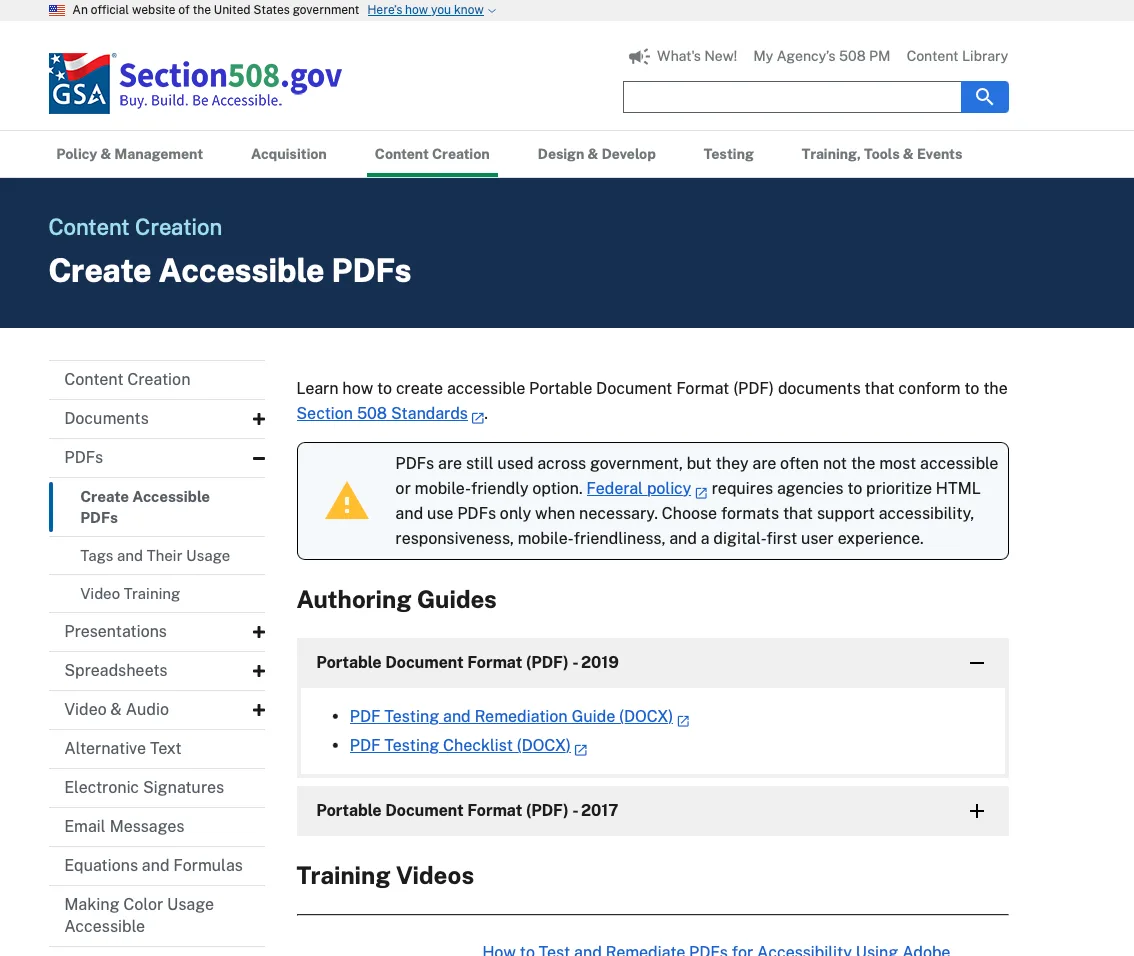
Section508.gov states the following on its "Create Accessible PDFs" page, reviewed and updated August 2025:
"PDFs are still used across government, but they are often not the most accessible or mobile-friendly option. Federal policy requires agencies to prioritize HTML and use PDFs only when necessary. Choose formats that support accessibility, responsiveness, mobile-friendliness, and a digital-first user experience."
The "federal policy" referenced in that passage links to OMB Memorandum M-24-08, Strengthening Digital Accessibility and the Management of Section 508 of the Rehabilitation Act. That memorandum is the executive branch policy basis for the federal HTML-first direction across federal agencies and the contractors that serve them.
Where Section 508 applies and where Title II applies
Section 508 of the Rehabilitation Act, as operationalised through OMB M-24-08 and Section508.gov guidance, covers federal executive branch agencies. The 2024 DOJ Title II web and mobile accessibility rule covers state and local government. The two regimes carry different enforcement routes but converge on the same operational direction for documents.
The Title II rule itself is format-neutral. It requires covered web content, including documents, to meet WCAG 2.1 Level A and AA by the applicable compliance date. That deadline is April 2026 for state and local entities serving populations of 50,000 or more, and April 2027 for smaller entities. The rule does not mandate HTML over PDF.
What 28 CFR § 35.202 does is restrict when an entity can rely on a separate conforming alternate version in place of directly accessible primary content. That structural restriction, read alongside the ADA.gov technical assistance set out below, produces the same operational publishing direction at state and local level as Section 508 produces at federal level.
ADA.gov pages that address HTML, PDF, and document accessibility
The pages below contain explicit HTML versus PDF language, or directly address document accessibility in a Title II state and local context.
| ADA.gov page | Date | Contribution on HTML vs PDF |
|---|---|---|
| Accessibility of State and Local Government Websites to People with Disabilities | Last updated: 28 February 2020 | Directly recommends providing documents in HTML or another text-based format, even if also providing a PDF. |
| ADA Best Practices Tool Kit for State and Local Governments, Chapter 5: Website Accessibility Under Title II of the ADA | 7 May 2007 | States that text-based versions (including HTML) should be provided in addition to PDFs, for compatibility with assistive technologies. |
| Fact Sheet: New Rule on the Accessibility of Web Content and Mobile Apps Provided by State and Local Governments | 8 April 2024 | Explains how the 2024 Title II rule works, including that even when an exception applies, content may still need to be provided in an accessible format to someone who needs it. |
| Accessibility of Web Content and Mobile Apps Provided by State and Local Government Entities: A Small Entity Compliance Guide | 22 May 2024 | Explains, in plain English, how the 2024 Title II rule treats older documents (including PDFs) and why old PDF estates are a known challenge. |
| State and Local Governments: First Steps Toward Complying with the ADA Title II Web and Mobile Application Accessibility Rule | 8 January 2025 | Advises public entities to plan and prioritise remediation work because not everything can be addressed at once. |
Important context for publication use: the "Accessibility of State and Local Government Websites…" page carries a note stating that it does not reflect the 2024 requirements and directs readers to the newer rule materials.
ADA.gov operational statements that mirror the federal direction
On posting documents
"When posting documents on the website, always provide them in HTML or a text-based format."
This is ADA.gov's direct operational parallel to the Section 508 position. It does not ask public entities to remove PDFs from their websites. It recommends the content is also available in a text-based format.
On PDFs alongside HTML and RTF
"Always provide documents in an alternative text-based format, such as HTML or RTF (Rich Text Format), in addition to PDF."
The operational direction is consistent with Section 508's: a text-based format as the primary published channel, PDF retained where needed.
On legacy PDF volume and prioritisation
"Some state and local governments have a lot of old documents, like PDFs, on their website."
"you may not be able to tackle all the issues for every type of your public entity's content at once."
ADA.gov itself recognises the scale of existing PDF estates and treats a phased, prioritised approach as the expected pattern rather than a single all-at-once exercise.
On accessible format where an exception applies
"provide the content to a person with a disability who needs it in a format that is accessible to them."
Even where specific content falls within an exception to the WCAG conformance requirement, access in an accessible format remains expected where a person with a disability needs it.
The limit on conforming alternate versions
"only where it is not possible to make web content directly accessible due to technical or legal limitations."
28 CFR § 35.202 restricts when a separate alternate version can substitute for directly accessible web content. For document publishing, this steers state and local entities away from treating a single isolated alternate as a blanket replacement for directly accessible primary content. The practical implication for a live site with a large PDF estate is that published content should be accessible in its own right wherever possible, rather than relying on a one-off alternate for all documents.
Related DOJ and ADA regulatory citations
The citations below are the core legal anchors a US public entity typically references for governance, policy, and public-facing statements on web content and document accessibility.
DOJ Title II final rule (Federal Register publication)
federalregister.gov › 2024-07758
The official publication of the 2024 DOJ rule establishing enforceable accessibility requirements for state and local government web content and mobile apps. It is the legal origin for Subpart H in 28 CFR Part 35.
28 CFR § 35.200 (Requirements for web and mobile accessibility)
ecfr.gov › § 35.200
Sets the baseline obligation for public entities' web content and mobile apps to be readily accessible to and usable by individuals with disabilities, and sets the compliance dates and the WCAG 2.1 Level A and AA conformance requirement.
28 CFR § 35.202 (Conforming alternate versions)
ecfr.gov › § 35.202
Restricts use of conforming alternate versions to limited circumstances. Directly relevant to any HTML-alongside-PDF approach.
28 CFR § 35.203 (Equivalent facilitation)
ecfr.gov › § 35.203
Preserves flexibility to use alternative methods, provided they result in substantially equivalent or greater accessibility and usability.
28 CFR § 35.205 (Effect of noncompliance that has a minimal impact on access)
ecfr.gov › § 35.205
Provides a narrow pathway where a minor technical nonconformance does not materially affect access, with emphasis on evaluation of access outcomes.
28 CFR § 35.160 (Effective communication)
ecfr.gov › § 35.160
Longstanding Title II communications rule that supports providing information in accessible formats, in a timely manner, and in a way that protects privacy and independence.
Suggested short website wording for US public entities
The wording below is drawn from ADA.gov and Section 508 language and is written to avoid overstatement.
Variant A
We publish information on this website in formats intended to be accessible to people with disabilities. Where we post documents, we also provide the information in HTML or another text-based format where practicable. If you need information from a document in an accessible format, contact us and we will provide the content in a format that is accessible to you.
Variant B
Some content on this website is provided in document formats such as PDFs. Where possible, we provide documents in HTML or another text-based format as well. If you cannot access any content because of a disability, tell us what you need and we will provide the content in an accessible format.
Variant C
We are working to ensure that our web content, including documents, is accessible. Because not all accessibility issues can be addressed at once across all content types, we prioritise fixes for high-impact and frequently used content. If you need a document in an accessible format, contact us and we will respond with an accessible version of the content.
Source appendix with URLs and retrieval dates
Retrieval date for all sources: 20 April 2026.
Section 508 federal source
- Create Accessible PDFs (Reviewed / Updated August 2025).
- OMB Memorandum M-24-08: Strengthening Digital Accessibility and the Management of Section 508 of the Rehabilitation Act.
ADA.gov sources
- Accessibility of State and Local Government Websites to People with Disabilities (Last updated: 28 February 2020).
- ADA Best Practices Tool Kit, Chapter 5: Website Accessibility Under Title II of the ADA (7 May 2007).
- Fact Sheet: New Rule on the Accessibility of Web Content and Mobile Apps Provided by State and Local Governments (8 April 2024).
- A Small Entity Compliance Guide (22 May 2024).
- State and Local Governments: First Steps Toward Complying with the ADA Title II Web and Mobile Application Accessibility Rule (8 January 2025).