PDF CONTENT MADE AI-READY. MORE ACCESSIBLE TOO.
Content shouldn't createbarriers or liability.
Your PDFs have 2 audiences: people, and AI. 98%* of organisations use PDFs, some poorly 'technically' created and not suitable for AI. Left unresolved, this creates unnecessary legal exposure, AI misrepresentation and / or hallucination risk.
AiCM finds the PDFs on your site and converts them into AI-ready web versions that LLMs and AI agents can read accurately, with screen reader accessibility included.
- Unlimited PDFs
- Unlimited websites
- Fixed fee

* Source: SmallPDF
The blind spot
Only 3% of organisations are AI-ready looking outside in.
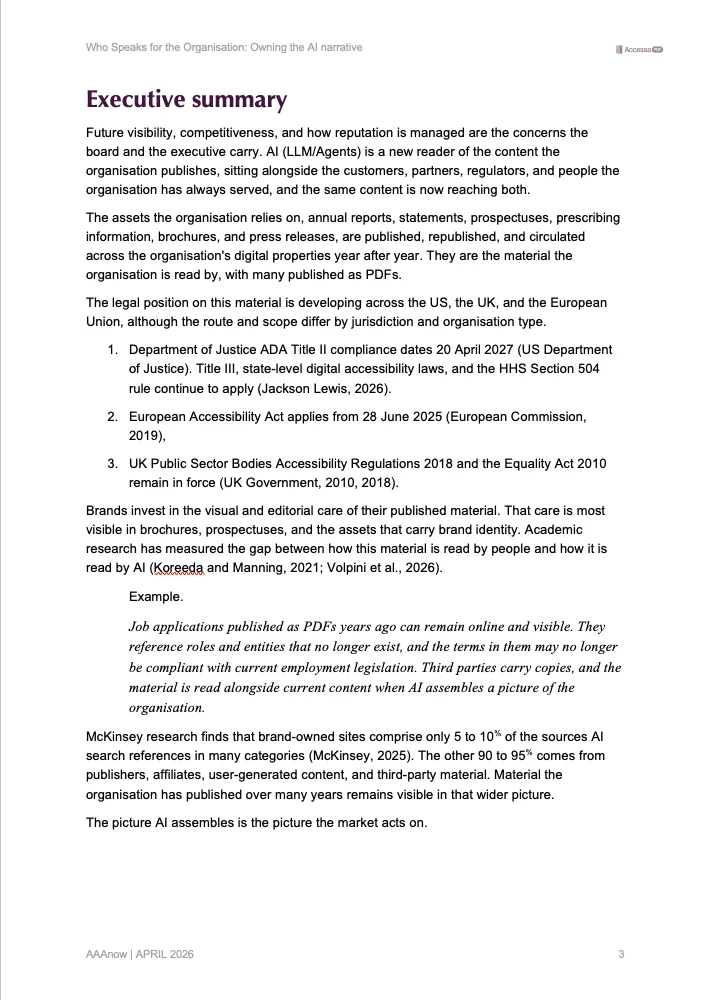
AI readiness is not only about internal tools. It depends on whether people and AI can reach, interpret, and trust what your organisation has already published, including content on partner websites and in archives.
PDFs are the historic blind spot. Web pages have standards and review workflows; PDFs rarely do. They are authored individually and handed to partners or added to your site without the same scrutiny, leaving years of material that people and AI cannot reliably read.
AI is the new front door
The majority of search now happens through AI. Your PDFs are what it finds.
When a visitor asks an AI assistant a question about your organisation, the assistant reads what it can find on your website. Where the answer lives inside a PDF, most of the useful signal is lost: no reliable text order, no headings, no tables it can parse, no alt text on the diagrams. What comes back to the visitor is an approximation, at best. At worst, it is an invention on a document you published under your own name.
The same conversion that gives an AI system a clean copy to read gives every other visitor a clean copy too, including people using assistive technology. One fix, two audiences, one version of your organisation being read on the outside.
AI is the majority of search
People increasingly ask AI assistants first and follow up on a website second. The version of your organisation those assistants report back is being assembled from whatever content they can actually read.
What AI sees in a PDF
A visual layout, often scanned, with broken reading order and no structure it can rely on. Often there can be contradictions (especially with older docs) creating misinformation. Where the content is regulated, the summary the assistant produces is a guess on a document you signed off.
Value of AI having accurate HTML
Clean headings, reliable reading order, tables restructured allowing easy, accurate parsing, described images. The version an AI system quotes is the version you actually published. Screen readers get the same clean copy.
WITH ARTY SUPPORTING YOU - THE PDF PROBLEM YOU DO NOT WANT, IS NOW YOUR AI ADVANTAGE
The AiCM PlatformEnterprise confidence. Zero complexity.
Cost
95%Lower than manual remediation
Automated conversion replaces specialist agencies and in-house tagging teams. Inclusive (people and AI) output, in a fraction of the time or cost.
Speed
99%Faster than manual remediation
What previously required weeks of specialist correction, updates and review is now dealt with automatically.
Ease
100%Hands-off operation
No discovery, no remediation, no uploading, no visitor support burden, no multi-version management. It runs itself.
Owning your AI narrative
Whitepaper
Who Speaks for the Organisation
Reputation, competitive standing, and the regulatory ground the organisation stands on are read from the content it has put online over many years and continues to publish, by AI now and by the people it has always served.
In summary: The PDF problem you do not want is now the AI advantage
Partner with us
Platform vendor? Agency partner?
Looking to partner with us? Open new doors, resell to your clients or become a sales agent. Partners fall into 4 groups: CMS Platforms, Digital Agencies, PDF remediation specialists and Sales agents.
About Us
Built on Evidence, Not Assumptions.
We've been doing this for 25 years. For the last 2 years, we've been training AI on understanding value and risk mapping against our own unique dataset of over 3.7 trillion data points.
3.7
trillion
Data points in our own dataset, used to train our AI on mapping value and risk.
$106
billion
Estimated manual effort avoided through automation. It is an estimate. Too much to count these days.
119
million
Websites analysed to map content fundamentals and build AI allowing interpretation of Value and Risk.
25
years
When we started, we were labelled 'the pioneers' of website automation and checking.
Who's talking about us